
Top Best AI Visibility Tools in 2026: Track How Your Brand Appears in AI Search
Have you noticed your website traffic dipping lately—even though your rankings seem stable?
You’re not imagining things. The way people find information online has changed.
AI-driven platforms like ChatGPT, Perplexity, Claude, and Google’s AI Overviews are now giving users direct answers, often without requiring a single click to your site. It’s the rise of zero-click AI search—and it’s reshaping how visibility works online.
If your brand isn’t showing up in AI-generated answers, you might be losing visibility without realizing it. Traditional analytics tools like Google Analytics or Search Console won’t show that gap.
That’s where AI visibility tools come in.
These new platforms track when, where, and how your brand appears inside AI responses. They measure your presence across large language models (LLMs) and AI search engines—helping you understand whether your content strategy is resonating with AI systems.
In this article, we’ll explore why AI visibility tracking matters, and review the top AI visibility tools of 2026—from enterprise-grade platforms to affordable all-in-one SEO suites now adapted for the AI era.
Why AI Visibility Tools Are Critical in 2026
Search is transforming fast. Gartner predicts that traditional search volume will decline by 25% by 2026, replaced by AI-driven discovery through chatbots, virtual agents, and LLM-powered search tools.
This shift means that content visibility no longer stops at Google rankings.
Even if your SEO remains strong, your traffic can still fall if AI tools are giving users the answers before they ever visit your site.
Enter AI Visibility Tracking
AI visibility tools are built to solve that measurement gap. They tell you:
-
When and how often your brand is cited in AI-generated answers.
-
Which platforms (ChatGPT, Claude, Perplexity, Google AI Overviews, etc.) mention your brand or link to your content.
-
Whether you appear as a primary source, secondary reference, or simply mentioned by name.
-
How your AI presence trends over time—and how it compares to competitors.
Think of them as Google Analytics for AI search.
They let you see whether your LLM seeding, structured data, and AI-optimized content are actually paying off.
Traditional SEO metrics like rankings, backlinks, and page views still matter—but they’re only part of the story now. Without AI visibility insights, you’re essentially flying blind in a growing segment of online discovery.
Top 5 AI Visibility Tools in 2026
The AI visibility space has exploded over the past year. Some established SEO tools have added AI tracking, while new startups are emerging with specialized LLM monitoring technology.
After evaluating what’s currently available, here are the top five AI visibility tools leading the market in 2026.
1. Ubersuggest AI Visibility
Best for: Small businesses, agencies, and marketers who want AI visibility plus traditional SEO in one place.
Ubersuggest—long known as a powerful yet affordable SEO platform—has rolled out an impressive AI Visibility Dashboard that tracks brand presence across major LLMs.
Key Features:
-
Brand Mentions: Monitor how often your name or site appears in AI-generated responses.
-
Industry Rank: See how your visibility compares to competitors within your space.
-
Top Prompts: Discover which questions and prompts trigger mentions of your content in AI engines.
-
Competitor Tracking: Compare your AI citation trends side by side with rival brands.
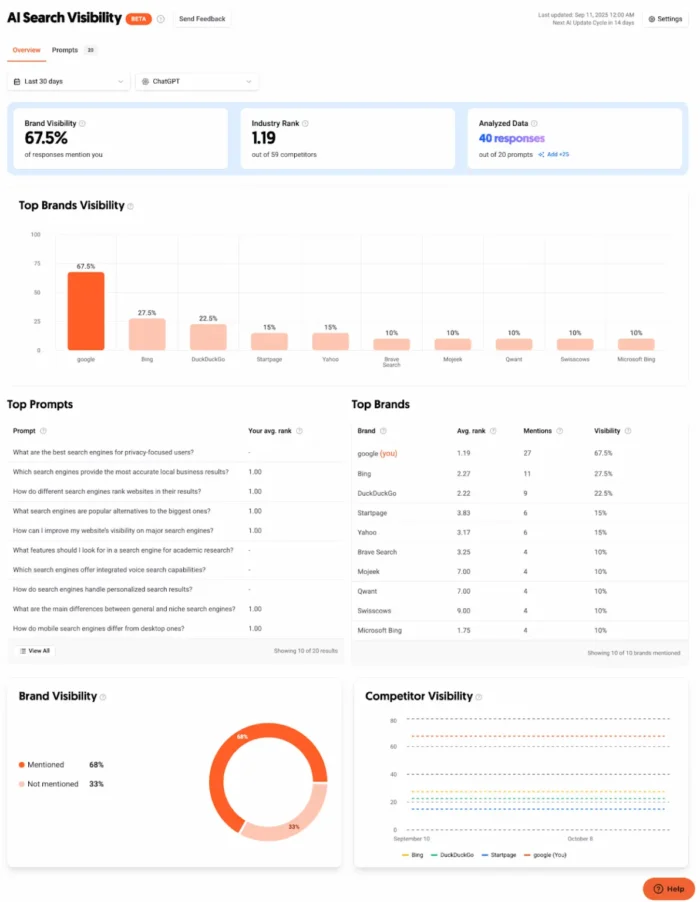
Ubersuggest’s AI module integrates seamlessly with its SEO suite, letting you connect AI citation data to your keyword rankings, backlinks, and traffic metrics. This gives you a holistic view of both traditional and AI-driven visibility.
The biggest advantage? Pricing simplicity. Ubersuggest offers flat-rate monthly pricing and unlimited project tracking, making it ideal for agencies managing multiple clients.
If you want one platform that balances cost, reliability, and comprehensive metrics, Ubersuggest AI Visibility is a strong first step into AI-era analytics.
2. Profound
Best for: Enterprise brands that need deep contextual analysis and customizable dashboards.
Profound is a new entrant built specifically for enterprise AI visibility and brand intelligence. Unlike most tools that simply count citations, Profound analyzes context, sentiment, and authority across AI-generated responses.
What Makes It Stand Out:
-
Sentiment Analysis: Understand how AI tools frame your brand—positively, negatively, or neutrally.
-
Competitive Mentions: Identify which competitors appear alongside you in AI answers.
-
Topic Authority Mapping: See which subjects AI models associate most strongly with your brand.
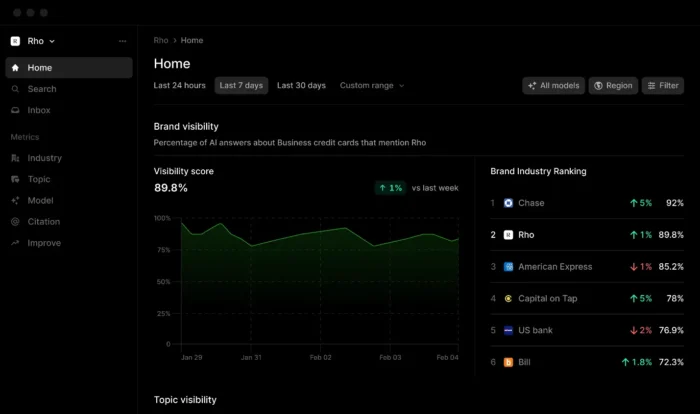
Profound’s real power lies in its customization. The platform offers tailored dashboards, integrates with internal analytics systems, and builds industry-specific reporting workflows—essential for regulated sectors like finance or healthcare.
It’s not cheap. Enterprise plans start in the high five figures annually, depending on data volume and customization. But for brands where AI-driven reputation and authority directly impact revenue, Profound’s depth justifies the investment.
3. Semrush AI Tracking
Best for: Existing Semrush users who want integrated AI and SEO visibility in one platform.
Semrush has expanded its massive SEO toolkit with AI visibility features that slot neatly into its existing reports. If your team already uses Semrush, this update means no extra logins or tools to manage.
Key Advantages:
-
Unified Dashboard: View your AI citations next to backlinks, keyword data, and rankings.
-
AI Visibility Score: Similar to domain authority, this gives a single score comparing your brand’s AI presence to competitors.
-
Cross-Channel Insights: See which pages earn both traditional backlinks and AI citations.
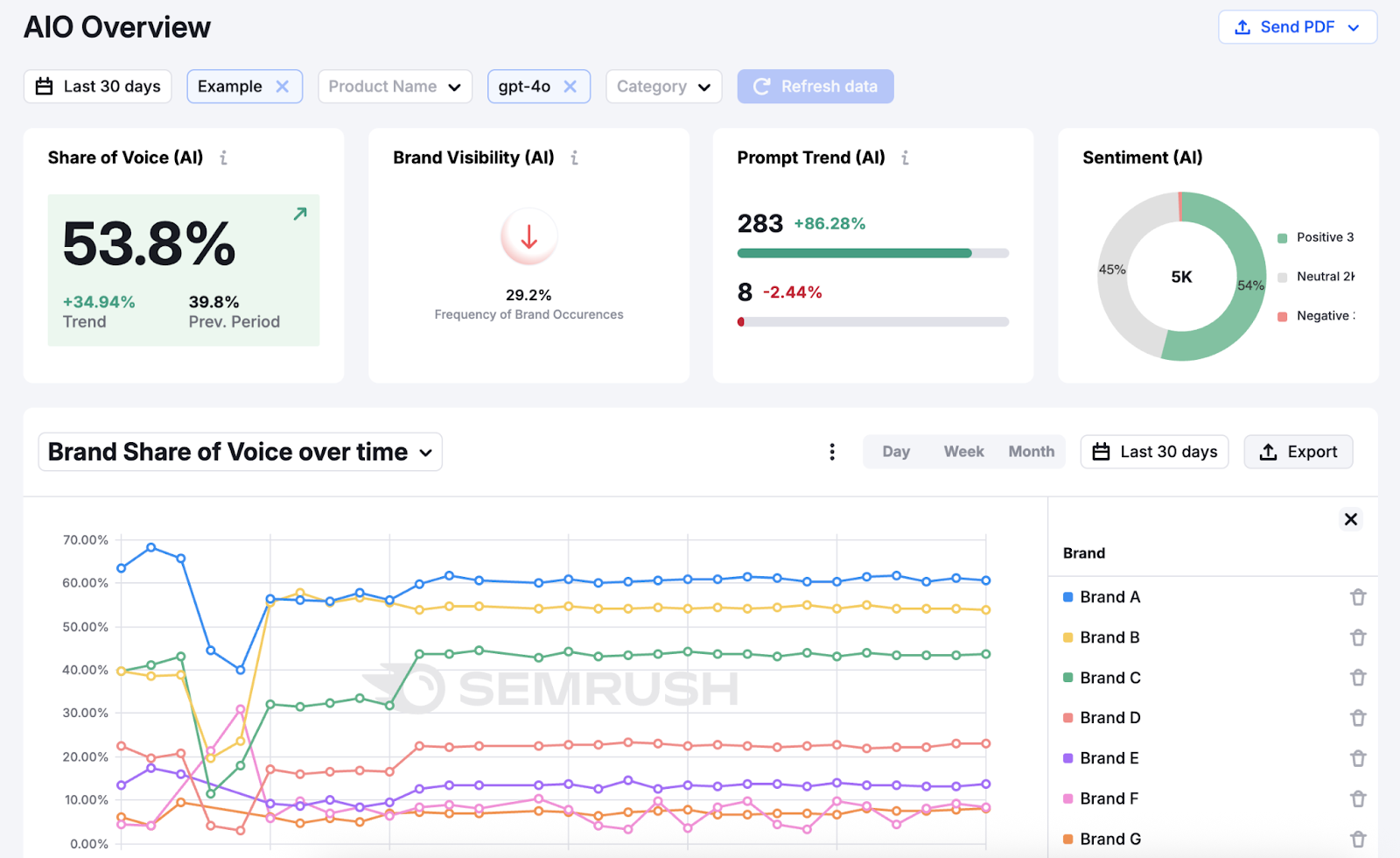
For teams already deep in Semrush’s ecosystem, adding AI visibility is a no-brainer. The platform connects your SEO performance and AI exposure, helping you understand which content performs best across all discovery channels.
The downside is scalability. Semrush limits project numbers per account tier, which can make costs climb quickly for large agencies. Still, it remains one of the most comprehensive and data-rich AI visibility options available.
4. Ahrefs AI Visibility
Best for: SEO teams focused on link building and authority-driven content strategies.
Ahrefs has entered the AI visibility space with a feature set that complements its legendary backlink intelligence. Its AI module tracks brand citations across ChatGPT, Perplexity, Bing AI, and others—while connecting them to your existing link and content data.
Key Highlights:
-
Cross-Data Correlation: See how backlinks influence AI citations.
-
Engine Filters: Filter visibility by platform (ChatGPT, Claude, etc.).
-
Trend Reports: Track visibility shifts over time and spot emerging opportunities.
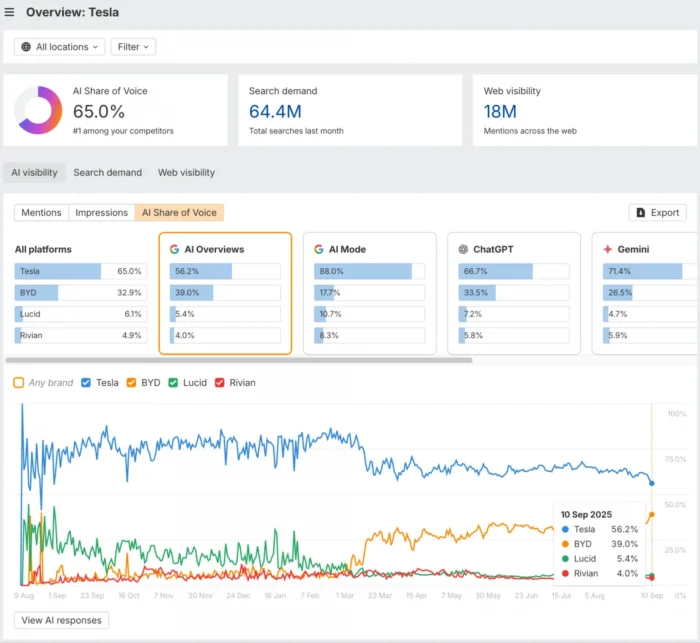
Ahrefs’ major advantage is its link data integration. The tool can show which of your linked pages are most likely to be cited by AI systems—valuable insight for content strategists who want to replicate that success.
However, Ahrefs’ pricing model mirrors Semrush’s—great for small teams, but pricey for agencies managing dozens of sites. Still, if you already rely on Ahrefs for SEO intelligence, its AI visibility module is a natural extension.
5. ScrunchAI
Best for: Brands that want a dedicated, LLM-first visibility platform.
ScrunchAI is one of the newer, specialized platforms built solely to monitor brand presence across AI engines—without the clutter of traditional SEO tools.
What It Offers:
-
Real-Time Tracking: Detect brand mentions and citations across ChatGPT, Claude, Perplexity, Bing AI, and Google’s AI Overviews.
-
Citation Quality Scores: Identify whether your brand appears as a trusted source, a passing mention, or in misinformation contexts.
-
Query Simulation: Test industry-specific prompts to see if (and where) your brand appears.
-
Content Recommendations: Get suggestions for improving visibility based on citation trends.
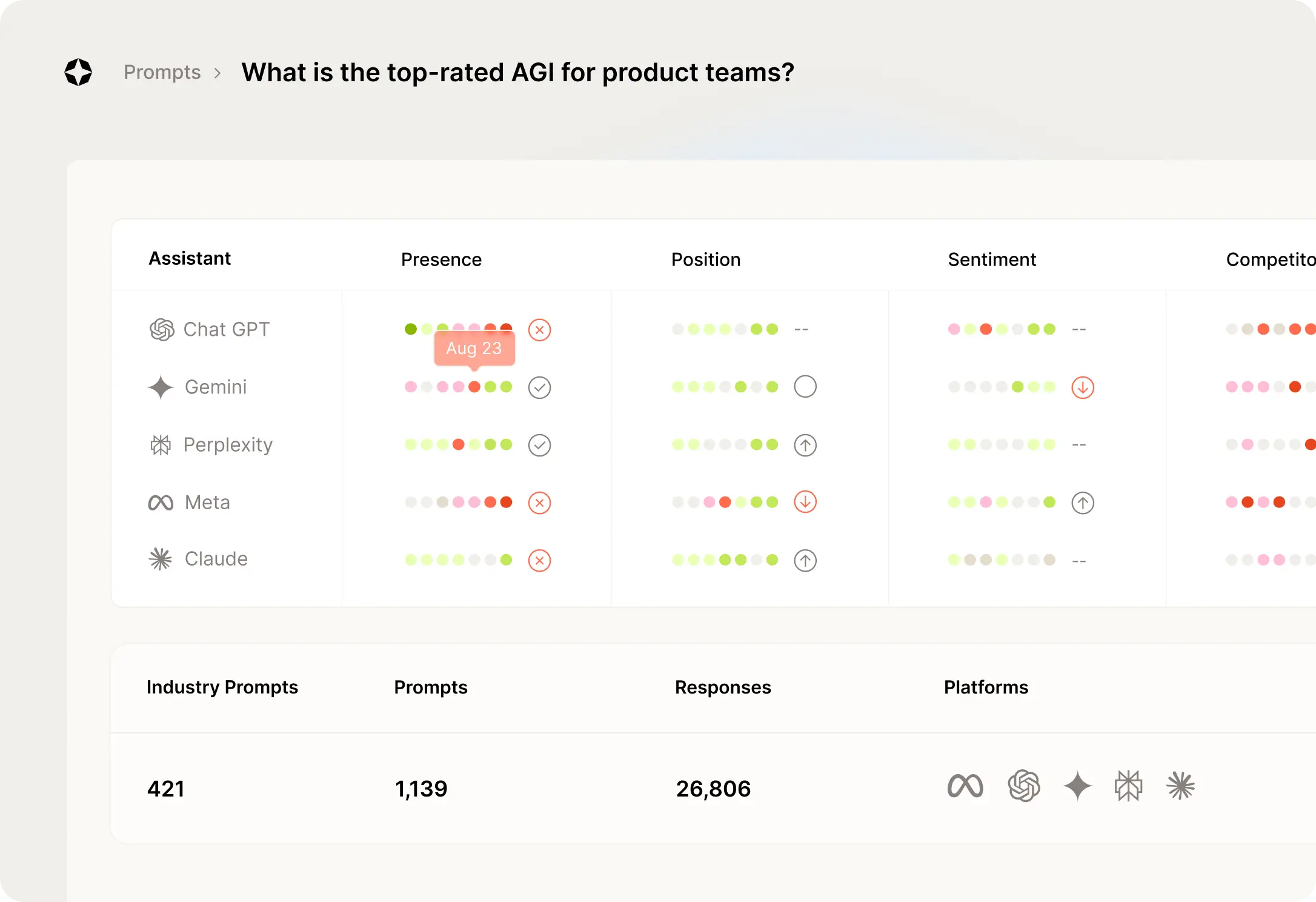
ScrunchAI’s simplicity and focus make it a strong choice for teams that already have SEO covered elsewhere and want dedicated AI visibility analytics.
Pricing is mid-range, scaling by query volume rather than project count—ideal for agencies that handle multiple clients. The only caveat: it’s a younger company, still building its reputation. But early users praise its accuracy, interface, and proactive updates.
How to Choose the Right AI Visibility Tool
The right platform depends on your team size, goals, and existing toolset. Here’s how to decide:
1. Budget
-
Tight budgets: Ubersuggest offers powerful features at a fraction of enterprise costs.
-
Enterprise budgets: Profound delivers unmatched customization and contextual intelligence.
2. Integration Needs
-
If you already use Semrush or Ahrefs, their AI visibility modules integrate seamlessly—no extra onboarding needed.
-
If you’re starting fresh or want an AI-only focus, ScrunchAI provides a streamlined approach.
3. Technical Skill Level
-
Some tools (like Profound) assume comfort with analytics and custom dashboards.
-
Others (like Ubersuggest and ScrunchAI) prioritize simplicity and actionable insights.
4. Scalability
-
Managing multiple clients? Go for tools with unlimited projects, like Ubersuggest.
-
Large enterprises should prioritize API access and integration flexibility, where Profound and Ahrefs shine.
5. Data Reliability
-
Established tools like Semrush and Ahrefs bring years of infrastructure to their AI tracking.
-
Newer entrants may innovate faster but might still refine data accuracy—so always test and compare.
The Future of AI Search (and Why You Need to Adapt Now)
AI search engines are not a passing trend—they’re quickly becoming the primary way people find information. Tools like Perplexity and Google AI Overviews are already influencing content visibility, and 2026 will see even deeper integration of AI into everyday search.
This means brands must optimize not just for Google, but for AI engines.
AI Tools provide you with the data to do that. They reveal which types of content LLMs favor, which sources get cited most often, and where your brand fits into that ecosystem.
Without this insight, you’re left guessing whether AI platforms even recognize your authority—or if competitors are quietly taking your place in AI-driven answers.
Summary Comparison: 2026 AI Visibility Power Matrix
| Feature / Tool | Ubersuggest | Profound | Semrush | Ahrefs | ScrunchAI |
|---|---|---|---|---|---|
| AI Citation Tracking | ✅ | ✅ | ✅ | ✅ | ✅ |
| Sentiment / Context Analysis | ❌ | ✅ | ❌ | ❌ | ✅ (basic) |
| SEO Integration | ✅ | Partial | ✅ | ✅ | ❌ |
| Ease of Use | ⭐⭐⭐⭐⭐ | ⭐⭐ | ⭐⭐⭐⭐ | ⭐⭐⭐ | ⭐⭐⭐⭐ |
| Enterprise Customization | ⭐⭐ | ⭐⭐⭐⭐⭐ | ⭐⭐⭐⭐ | ⭐⭐⭐ | ⭐⭐ |
| Pricing Flexibility | ⭐⭐⭐⭐⭐ | ⭐ | ⭐⭐ | ⭐⭐ | ⭐⭐⭐⭐ |
| Scalability for Agencies | ⭐⭐⭐⭐⭐ | ⭐⭐ | ⭐⭐ | ⭐⭐ | ⭐⭐⭐⭐ |
| Data Reliability | ⭐⭐⭐⭐ | ⭐⭐⭐⭐ | ⭐⭐⭐⭐⭐ | ⭐⭐⭐⭐⭐ | ⭐⭐⭐ |
| Innovation Speed | ⭐⭐⭐⭐ | ⭐⭐⭐ | ⭐⭐ | ⭐⭐ | ⭐⭐⭐⭐⭐ |
| Overall Score | 9.4 | 9.2 | 8.9 | 8.6 | 8.3 |
FAQs About AI Visibility Tools
1. What exactly is AI visibility?
AI visibility refers to how often—and how positively—your brand or content appears in AI-generated answers from platforms like ChatGPT, Claude, or Perplexity. It’s a new metric for understanding digital authority beyond traditional search.
2. Can AI visibility replace SEO?
No. AI visibility complements SEO. Traditional search rankings still matter for web traffic, but AI visibility helps measure your brand’s presence within zero-click AI ecosystems.
3. How do AI visibility tools collect data?
Most tools run structured prompt tests and LLM queries across multiple engines, analyzing which brands, URLs, or phrases appear in responses. Some also use APIs or partnerships with AI platforms for more accurate data.
4. Do these tools help improve AI visibility, or just track it?
Both. Some platforms—like ScrunchAI and Ubersuggest—offer actionable recommendations, helping you create content more likely to be cited by AI systems.
Conclusion: Don’t Wait to Measure What AI Already Sees
By 2026, AI search will influence nearly every customer journey. People will get answers faster—but fewer will click through to your website.
If you’re not tracking where your brand appears in AI-generated responses, you’re missing the new frontier of visibility.
The good news? Tools like Ubersuggest, Profound, Semrush, Ahrefs, and ScrunchAI make it possible to measure and optimize your AI presence today. Whether you want an affordable all-in-one platform or a deep enterprise solution, there’s a fit for every need.
The earlier you start tracking, the faster you’ll understand how AI perceives—and presents—your brand.
And in this next era of search, visibility inside AI answers may matter more than your position on page one.