
AEO in 2026: How to Get AI Answer Engines to Feature Your Business
By 2026, the way people search will have officially changed.
Typing keywords into Google is no longer the default. Instead, people ask ChatGPT, Gemini, Copilot, and Perplexity for direct answers — and they get them instantly, without ever visiting a website.
If your brand isn’t being mentioned in those AI-generated responses, you’re missing where more than half of digital attention now lives.
That’s where Answer Engine Optimization (AEO) comes in.
AEO is the next evolution of SEO — a strategy designed to make sure AI systems recognize, trust, and mention your business when they answer user questions.
Let’s explore what AEO looks like in 2026, why it’s critical, and what you can do right now to make AI engines talk about you — not your competitors.
Key Takeaways for 2026
-
Over 65% of searches now end without a click — thanks to AI-generated answers and voice summaries.
-
Answer engines like ChatGPT, Perplexity, Gemini, and Copilot act as “AI search layers,” delivering responses that summarize multiple sources.
-
AEO helps your business content become part of those summaries or citations.
-
The foundation of AEO is clarity, structure, authority, and credibility.
-
In 2026, AEO isn’t optional — it’s the only way to stay visible in AI-first discovery.
What Exactly Is Answer Engine Optimization (AEO)?
Answer Engine Optimization (AEO) is the process of making your content easily discoverable, understandable, and quotable by AI systems that generate direct responses.
It builds upon SEO but focuses on how large language models (LLMs) like GPT-5, Gemini 2, and Claude 3 interpret, summarize, and cite information.
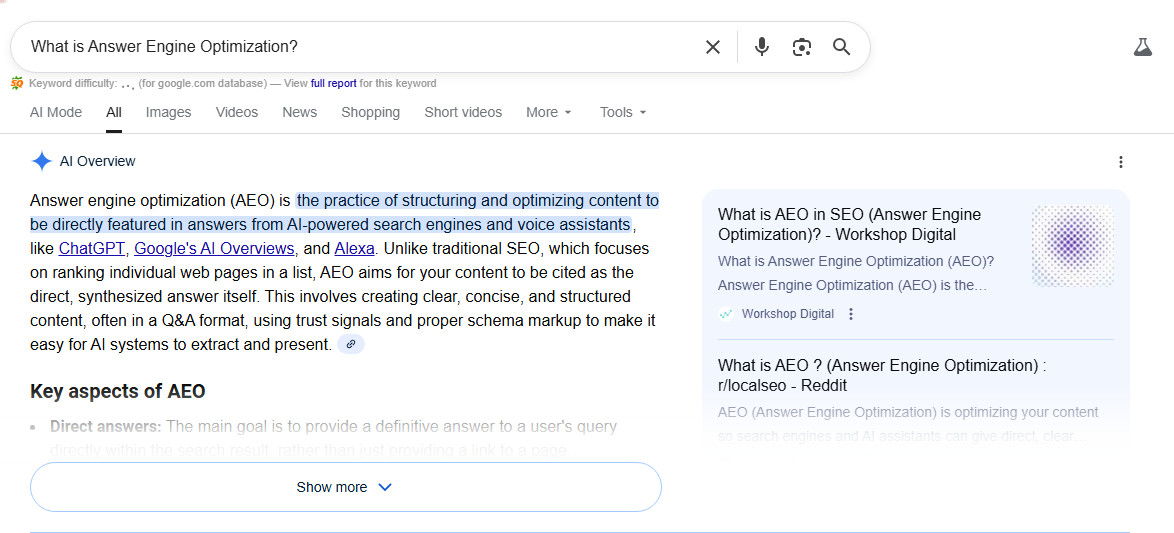 AI answer engines don’t crawl pages like traditional search bots. They extract structured knowledge — entities, facts, and relationships — from multiple data sources. AEO ensures your brand is part of that structured web of truth.
In other words, while SEO gets you ranked, AEO gets you mentioned.
Why AEO Matters More Than Ever in 2026
AI search is no longer experimental. It’s embedded into browsers, phones, and voice interfaces.
Microsoft Copilot powers Windows search. Google integrates Gemini directly into Chrome. ChatGPT is the default in OpenAI’s browser extension ecosystem.
Consumers ask, “What’s the best marketing agency in Austin?” or “Which coffee brand is sustainable?” — and AI answers instantly, often citing just one or two sources.
If your brand isn’t one of them, you’re invisible.
Zero-click search has become zero-option visibility — AI chooses which brands get shown. That makes AEO not just a marketing trend, but a survival strategy for online credibility.
AEO vs. SEO: What’s Changed in 2026
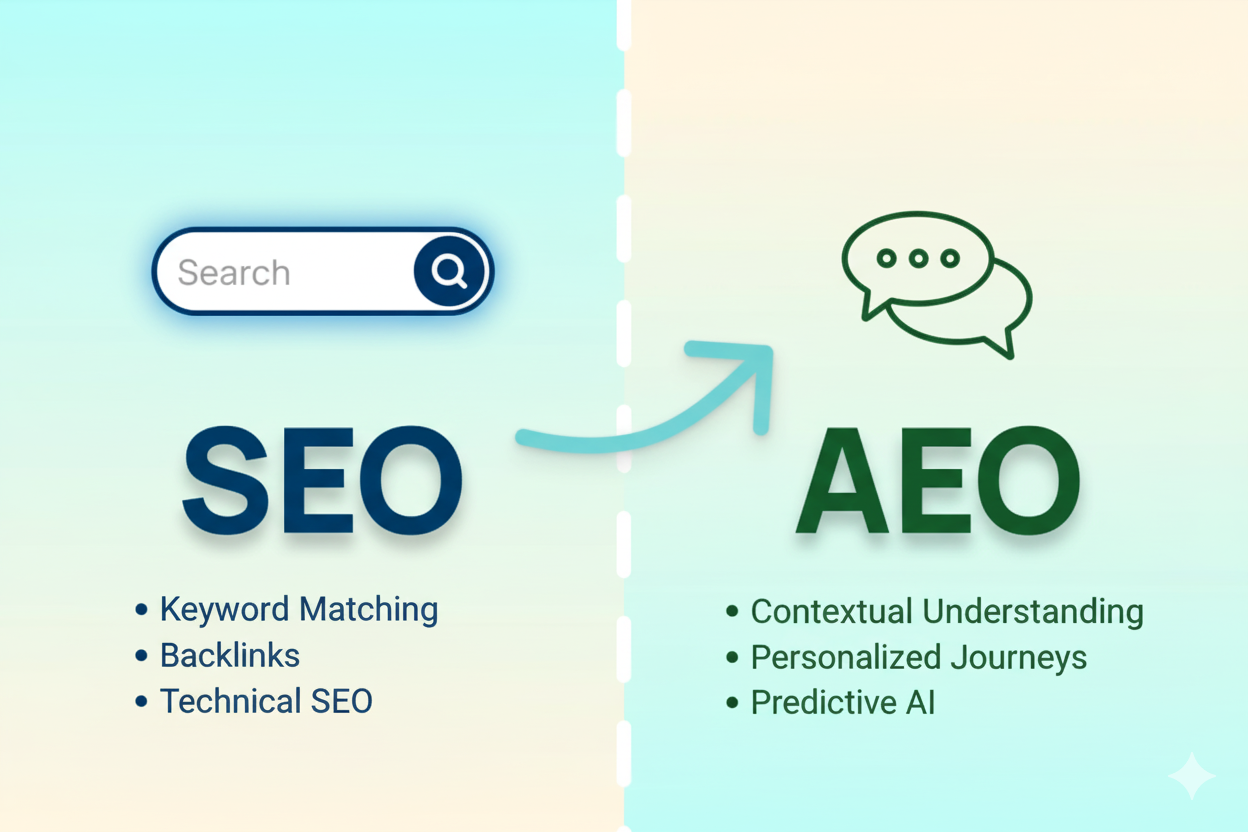
| Factor | SEO (Search Engine Optimization) | AEO (Answer Engine Optimization) |
|---|---|---|
| Goal | Rank on search results pages | Be featured or cited in AI-generated answers |
| User Behavior | Click-based discovery | Conversational, zero-click answers |
| Optimization Focus | Keywords, links, and meta tags | Entities, structured data, and authority |
| Primary Audience | Search algorithms | Large language models |
| Outcome | Visibility in rankings | Visibility in AI-generated responses |
SEO helps users find you.
AEO ensures AI systems recognize and trust you.
In 2026, brands that integrate both win.
How to Get AI Engines to Mention Your Business
1. Build Entity-Level Recognition
AI models understand the world through “entities” — structured representations of people, places, and brands.
Your first goal is to make sure your business exists as a verifiable entity across the web.
Do this by:
-
Ensuring consistent Name, Address, Phone (NAP) data across directories.
-
Linking your brand to its category (“[Brand] is a [type of business] in [location]”).
-
Creating or updating your Wikidata and Crunchbase entries.
-
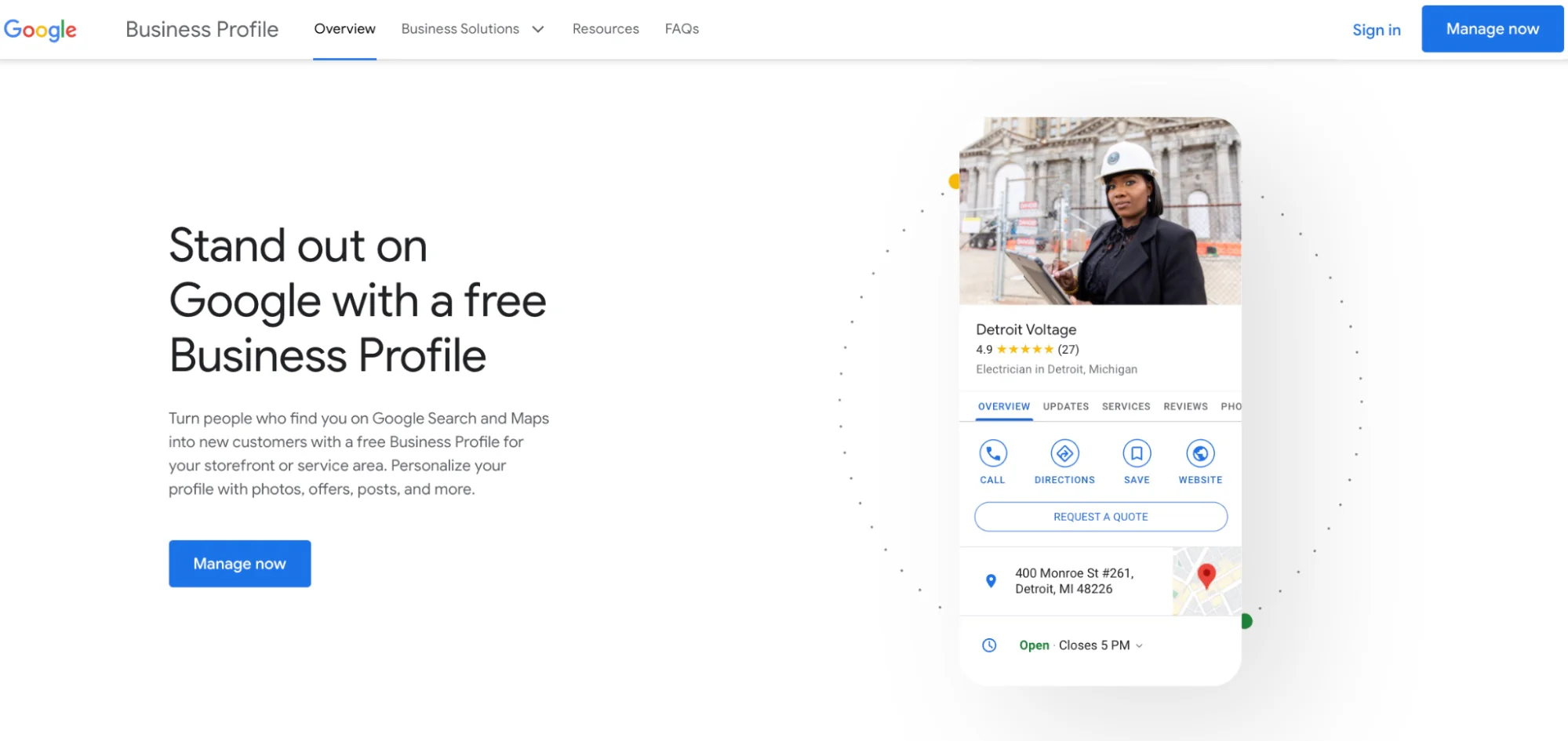
Claiming and optimizing your Google Business Profile and LinkedIn.
The more structured, consistent, and verifiable your entity data is, the easier it is for AI models to pull it confidently into answers.
2. Write Like You’re Answering a Question
AI systems favor direct, structured content.
Each page should clearly answer a user query — not just describe a topic.
Try this structure:
-
Question Heading (H2): “What Is AEO in 2026?”
-
Immediate Answer (2–3 sentences): Define it simply and directly.
-
Supporting Context: Expand with examples, visuals, and data.
Add FAQ sections to capture multiple question variations in one place.
This format improves readability for humans and machine interpretability for AI.
3. Add Schema and Structured Data Everywhere
By 2026, schema markup will have become essential for AEO.
Use structured data to label your content types, such as:
-
FAQ schema for Q&A content
-
Organization schema for brand details
-
Review the schema for testimonials
-
Product or Service schema for offerings
Tools like Schema.org, Rank Math, and Yoast make this simple.
Structured data helps AI confidently quote or summarize your content — without guessing context.
4. Build Real Authority Signals
AI models rely heavily on trust scores — signals that a source is credible, consistent, and well-cited.
To strengthen your brand authority:
-
Publish expert-authored content with visible credentials.
-
Earn high-quality backlinks from respected domains.
-
Get featured in industry directories, podcasts, or media outlets.
-
Encourage third-party reviews across platforms like G2, Yelp, and Trustpilot.
When AI sees multiple trustworthy references pointing to your brand, you become part of its “trusted knowledge graph.”
5. Optimize for Conversational Intent
AI searches are phrased in natural language, not just keywords.
People now ask:
“Which is better for small businesses — Squarespace or Wix?”
“What’s the best local bakery open right now?”
These questions combine intent + context.
To capture them:
-
Use long-tail, conversational phrases in your content.
-
Include comparisons, pros/cons, and step-by-step explanations.
-
Focus on user problems rather than product features.
AI tools aim to deliver nuanced, conversational responses — provide them with the structure they need to include you.
6. Keep Brand Data Updated Across Platforms
ChatGPT, Perplexity, and Gemini don’t just scrape your website — they triangulate your data across dozens of sources.

Make sure your business details (hours, pricing, reviews, product updates) are synchronized across:
-
Yelp & Bing Places
-
Apple Maps
-
LinkedIn
-
Social channels
-
Knowledge graph entries
Outdated data is a fast track to being excluded from AI answers.
7. Leverage AI Tools for Testing and Optimization
Use AI itself to test your visibility.
Ask ChatGPT or Gemini:
“Who are the top companies offering [your service] in [your area]?”
If you’re not in the answer — that’s your AEO gap.
AI tools can also help you:
-
Generate question-based content ideas
-
Identify missing entities or schema
-
Test the readability and clarity of your answers
Let the same systems that rank you help you improve.
How AI Chooses Which Brands to Mention
Based on 2026 analysis from multiple AI optimization agencies, the most influential factors for being mentioned in AI-generated answers are:
-
Entity credibility: Verified business or organization identity.
-
Cross-platform consistency: Matching data across listings and profiles.
-
Author authority: Expert or organization recognized in its field.
-
Relevance and clarity: Content matches user intent and is well-structured.
-
User signals: Positive reviews, citations, and backlinks.
-
Recency: Fresh, regularly updated content.
AI doesn’t just “index” — it interprets trust.
Your job is to make that trust easy to confirm.
Monitoring Your AEO Performance
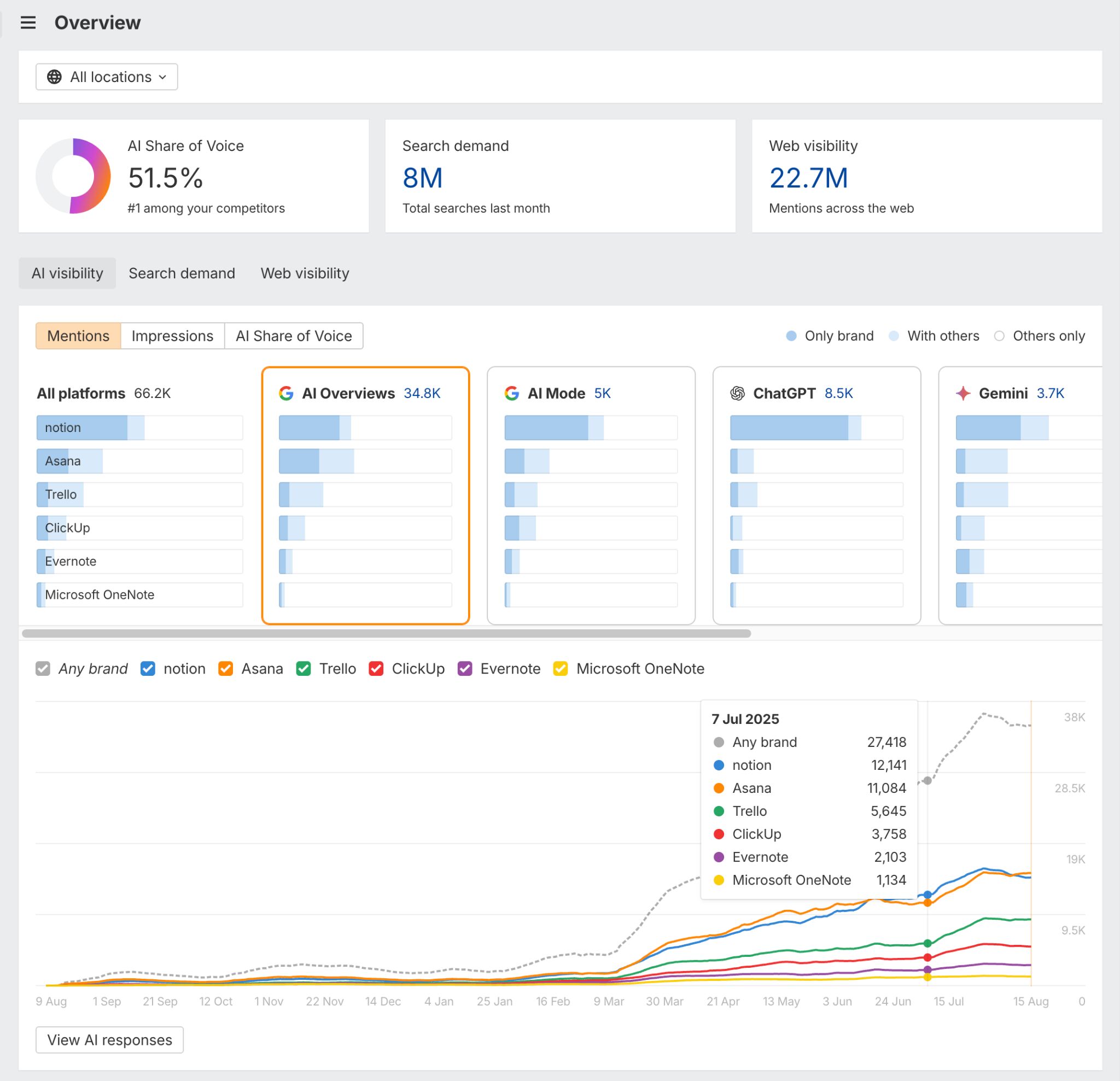
AEO performance is measured not by clicks, but by mentions, citations, and visibility inside AI platforms.
Track your progress by:
-
Regularly prompting ChatGPT, Gemini, and Perplexity with industry queries.
-
Using AI visibility tracking tools (e.g., Ubersuggest Profound, MarketMuse AI, or BrightEdge Copilot).
-
Monitoring branded mentions in AI-generated search reports.
-
Logging how often your brand appears in AI snapshots or summaries.
Adjust, update, and re-optimize quarterly.
AEO is dynamic — the AI landscape evolves fast.
The Future of AEO: From Optimization to Collaboration
In 2026, AEO is shifting from optimization to integration.
Businesses are now building AI-friendly APIs, structured datasets, and verified content feeds designed for direct ingestion by LLMs.
The next phase of AEO isn’t just “getting mentioned” — it’s becoming a data source.
Brands that prepare their content for machine consumption — with clear metadata, verified facts, and consistent authority signals — will dominate the next decade of AI search.
FAQs
What is Answer Engine Optimization (AEO)?
Answer Engine Optimization (AEO) is the practice of shaping your content so it can be discovered, understood, and featured in AI-generated responses. It ensures tools like ChatGPT, Gemini, Perplexity, and Google’s AI Overviews recognize your information as clear, credible, and relevant.
AEO takes the foundation of SEO — keywords, authority, and structure — and evolves it for the era of zero-click, conversational search, where AI provides the answer directly to the user.
How can I implement AEO for my business?
To start, identify the questions your audience is asking and craft content that gives direct, well-structured answers.
Use:
-
Question-based headings (“What is,” “How to,” “Best ways to”)
-
Schema markup for FAQs and articles
-
Short summaries and bullet points for clarity
-
Updated, authoritative information backed by reliable sources
Then, monitor how often your content or brand appears in AI-generated results, and refine based on visibility gaps. The more your content aligns with real user intent, the more likely it is to be chosen by answer engines.
How is AEO different from traditional SEO?
While SEO aims to rank your website higher on search result pages, AEO focuses on getting your content featured within AI-generated answers.
Both share common foundations — quality content, authority, and relevance — but AEO demands a sharper focus on:
-
Structured data (schema and entities)
-
Concise, question-driven content
-
Machine readability and factual accuracy
In short, SEO helps people find your site.
AEO helps AI engines find you — and mention your business in their answers.
Final Thoughts
In 2026, being findable on Google isn’t enough.
You need to be recognizable by AI.
Answer engines are the new gatekeepers of visibility — and they reward brands that are structured, credible, and easy to understand.
If your content isn’t ready to be read by machines, it won’t be seen by people.
The sooner you invest in AEO, the sooner AI will start talking about your business — and recommending it.
Because in the world of AI-first discovery, you’re either the answer… or you’re invisible.
At Triitans Solitaire, we help businesses stay visible in that new reality — by turning traditional SEO strategies into AI-optimized visibility systems that make brands part of the answers people trust.